 |
Blaze 0.0.1
The ultra high-performance JSON Schema evaluator
|

|
|
Blaze 0.0.1
The ultra high-performance JSON Schema evaluator
|
|
A static analysis pass that maps URIs and pointers to subschemas. More...
Classes | |
| class | sourcemeta::blaze::SchemaFrame |
| class | sourcemeta::blaze::SchemaFrameError |
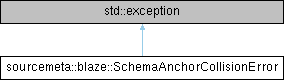
| class | sourcemeta::blaze::SchemaAnchorCollisionError |
Enumerations | |
| enum class | sourcemeta::blaze::SchemaFrame::LocationType : std::uint8_t { Resource , Anchor , Pointer , Subschema } |
A static analysis pass that maps URIs and pointers to subschemas.
This functionality is included as follows:
| class sourcemeta::blaze::SchemaFrame |
This class performs a static analysis pass on the input schema, computing things such as the static identifiers and references of a schema.
For example:
Public Types | |
| enum class | Mode : std::uint8_t { Locations , References } |
| enum class | LocationType : std::uint8_t { Resource , Anchor , Pointer , Subschema } |
| using | References = std::map< std::pair< SchemaReferenceType, sourcemeta::core::WeakPointer >, ReferencesEntry > |
| using | Locations = std::map< std::pair< SchemaReferenceType, sourcemeta::core::JSON::String >, Location > |
| using | Paths = std::vector< sourcemeta::core::WeakPointer > |
| A list of paths to frame within a schema wrapper. | |
Public Member Functions | |
| SchemaFrame (const Mode mode) | |
| SchemaFrame (const SchemaFrame &)=delete | |
| auto | operator= (const SchemaFrame &) -> SchemaFrame &=delete |
| SchemaFrame (SchemaFrame &&)=delete | |
| auto | operator= (SchemaFrame &&) -> SchemaFrame &=delete |
| auto | mode () const noexcept -> Mode |
| auto | to_json (const std::optional< sourcemeta::core::PointerPositionTracker > &tracker=std::nullopt) const -> sourcemeta::core::JSON |
| Export the frame entries as JSON. | |
| auto | analyse (const sourcemeta::core::JSON &root, const SchemaWalker &walker, const SchemaResolver &resolver, std::string_view default_dialect="", std::string_view default_id="", const Paths &paths={sourcemeta::core::empty_weak_pointer}) -> void |
| auto | locations () const noexcept -> const Locations & |
| Access the analysed schema locations. | |
| auto | references () const noexcept -> const References & |
| Access the analysed schema references. | |
| auto | reference (const SchemaReferenceType type, const sourcemeta::core::WeakPointer &pointer) const -> std::optional< std::reference_wrapper< const ReferencesEntry > > |
| Get a specific reference entry by type and pointer. | |
| auto | standalone () const noexcept -> bool |
| Check whether the analysed schema has no external references. | |
| auto | root () const noexcept -> const sourcemeta::core::JSON::String & |
| Get the root schema identifier (empty if none) | |
| auto | vocabularies (const Location &location, const SchemaResolver &resolver) const -> Vocabularies |
| Get the vocabularies associated with a location entry. | |
| auto | uri (const Location &location, const sourcemeta::core::WeakPointer &relative_schema_location=sourcemeta::core::empty_weak_pointer) const -> sourcemeta::core::JSON::String |
| Get the URI associated with a location entry. | |
| auto | traverse (const Location &location, const sourcemeta::core::WeakPointer &relative_schema_location) const -> const Location & |
| Get the location associated by traversing a pointer from another location. | |
| auto | traverse (const std::string_view uri) const -> std::optional< std::reference_wrapper< const Location > > |
| Get the location associated with a given URI. | |
| auto | traverse (const sourcemeta::core::WeakPointer &pointer) const -> std::optional< std::reference_wrapper< const Location > > |
| Get the location associated with a given pointer. | |
| auto | traverse (const sourcemeta::core::WeakPointer &pointer, const LocationType type) const -> std::optional< std::reference_wrapper< const Location > > |
| Get the location of a specific type associated with a given pointer. | |
| auto | uri (const sourcemeta::core::WeakPointer &pointer) const -> std::optional< std::reference_wrapper< const sourcemeta::core::JSON::String > > |
| Turn an absolute pointer into a location URI. | |
| auto | dereference (const Location &location, const sourcemeta::core::WeakPointer &relative_schema_location=sourcemeta::core::empty_weak_pointer) const -> std::pair< SchemaReferenceType, std::optional< std::reference_wrapper< const Location > > > |
| Try to dereference a reference location into its destination location. | |
| template<std::invocable< std::string_view > F> | |
| auto | for_each_resource_uri (const F &callback) const -> void |
| Iterate over all resource URIs in the frame. | |
| template<std::invocable< const sourcemeta::core::WeakPointer &, const ReferencesEntry & > F> | |
| auto | for_each_unresolved_reference (const F &callback) const -> void |
| auto | has_references_to (const sourcemeta::core::WeakPointer &pointer) const -> bool |
| Check if there are any references to a given location pointer. | |
| auto | has_references_through (const sourcemeta::core::WeakPointer &pointer) const -> bool |
| Check if there are any references that go through a given location pointer. | |
| auto | has_references_through (const sourcemeta::core::WeakPointer &pointer, const sourcemeta::core::WeakPointer::Token &tail) const -> bool |
| auto | relative_instance_location (const Location &location) const -> sourcemeta::core::WeakPointer |
| Get the relative instance location pointer for a given location entry. | |
| auto | empty () const noexcept -> bool |
| Check if the frame has no analysed data. | |
| auto | reset () -> void |
| Reset the frame, clearing all analysed data. | |
| auto | is_reachable (const Location &base, const Location &location, const SchemaWalker &walker, const SchemaResolver &resolver) const -> bool |
| Determines if a location could be evaluated during validation. | |
| using sourcemeta::blaze::SchemaFrame::Locations = std::map<std::pair<SchemaReferenceType, sourcemeta::core::JSON::String>, Location> |
A JSON Schema reference frame is a mapping of URIs to schema identifiers, JSON Pointers within the schema, and subschemas dialects. We call it reference frame as this mapping is essential for resolving references.
| using sourcemeta::blaze::SchemaFrame::References = std::map<std::pair<SchemaReferenceType, sourcemeta::core::WeakPointer>, ReferencesEntry> |
A JSON Schema reference map is a mapping of a JSON Pointer of a subschema to a destination static reference URI. For convenience, the value consists of the URI on its entirety, but also broken down by its potential fragment component. The reference type is part of the key as it is possible to have a static and a dynamic reference to the same location on the same schema object.
|
strong |
The mode of framing. More extensive analysis can be compute and memory intensive
| auto sourcemeta::blaze::SchemaFrame::analyse | ( | const sourcemeta::core::JSON & | root, |
| const SchemaWalker & | walker, | ||
| const SchemaResolver & | resolver, | ||
| std::string_view | default_dialect = "", |
||
| std::string_view | default_id = "", |
||
| const Paths & | paths = {sourcemeta::core::empty_weak_pointer} |
||
| ) | -> void |
Analyse a schema or set of schemas from a given root. Passing multiple paths that have any overlap is undefined behaviour
|
inline |
Iterate over all unresolved references (where destination cannot be traversed)
| auto sourcemeta::blaze::SchemaFrame::has_references_through | ( | const sourcemeta::core::WeakPointer & | pointer, |
| const sourcemeta::core::WeakPointer::Token & | tail | ||
| ) | const -> bool |
Check if there are any references that go through a given location pointer with a tail token
| class sourcemeta::blaze::SchemaFrameError |
An error that represents a schema frame error
| class sourcemeta::blaze::SchemaAnchorCollisionError |
An error that represents a schema anchor collision error
|
strong |
The type of a location frame
 1.9.8
1.9.8